
Georgetown Busted Mugshots
Georgetown is Quitman County's seat and its only incorporated city. Legally, it is the Georgetown-Quitman County unified government. The April 1, 2020 Census place table counted 2,235 residents, and the county history backs up the single-city status. County planning documents give every police function to the sheriff. So the Quitman County Sheriff's Office is the local contact for arrests and incidents. A search for a city blotter or a Georgetown Police Department list starts in the wrong place.
Booking photos travel with the person, not the town. Sheriff Charles Davis's office may hold the arrest or incident report. The receiving jail keeps the custody entry, intake sheet, and photo. No official Quitman roster, recent-bookings feed, or online booking-photo portal could be confirmed. No same-day, 48-hour, weekly, or archived online view turned up either. That gap does not mean no arrest happened. It may point to an offline records route or a transfer across county lines. Current custody and the final court outcome come from separate records.
Where Georgetown Busted Mugshots Appear
Start with one question. Who holds the record you want? The official sheriff landing page is the natural first stop, though the external sheriff domain it points to is unavailable. The Georgia Sheriffs' Association directory lists contact details for the office. It offers no separate jail address, phone number, chief jailer, roster, feed, or photo portal.
That gap shapes the whole search. Work it in order. Contact the sheriff first, pin down which jail received the person, then ask each records holder for the exact record you want. Treat news stories and archive sites as leads only, since neither proves current custody.
| Channel | Photo status | Official? | How to use it |
|---|---|---|---|
| Quitman County Sheriff | No online result verified | Yes | Call the sheriff to confirm the arrest and ask which facility received the person. |
| Receiving jail | Possible intake photo, if held there | Yes, after identification | Randolph County Jail is documented for some cases. Confirm the current facility before requesting its custody or intake record. |
| Written records request | Request the specific existing photo | Yes | Send a request to the sheriff and, when needed, a parallel request to the receiving jail. |
| Quitman court file | No booking photo | Yes | Use the Superior Court clerk or Georgia Courts e-access for the later case result. |
| GBI release | Case context, not a roster | Yes | Use an official event release to verify agencies, charges, and a named receiving facility. |
| WALB Quitman County News | No routine gallery; occasional imagery | No | Its exact county stream is irregular and event-driven, not a daily arrest list. |
| WTVM Crime | Occasional agency-supplied image | No | Its regional crime stream sometimes reports Georgetown events but is not a Quitman blotter. |
| Mugshots.com archive | Historical cards and photos | No | The visible Quitman archive is old and unofficial. It cannot establish current custody. |
Every channel does a different job. The sheriff tells you the arresting jurisdiction. The receiving jail confirms who is in custody right now. Court files hold the outcome. Local outlets like WALB and WTVM can explain what happened, while Mugshots.com may surface an old archive card. One Quitman archive showed 85 indexed records with visible dates running from 2011 through May 2015. No single source covers all the ground.
Note: A missing online entry can reflect an unverified feed, a transfer, or an offline record path rather than no arrest.
Busted in Georgetown: Find the Booking
Use the same routine every time. Gather the exact name first. Add an approximate arrest date if you have one. Then set the jurisdiction as Georgetown, Georgia or Quitman County. Two mix-ups trip people up often. Georgetown County sits in South Carolina, and the city of Quitman is over in Brooks County. Neither belongs in your search.
With no verified online roster or feed for the area, a phone call to the sheriff beats waiting for a list to refresh.
- Confirm the place. Match Georgetown, Georgia, Quitman County, the likely arresting agency, and the person's full name before following a result.
- Call the sheriff first. Ask whether the arrest or incident record exists and which jail currently holds, or held, the person.
- Follow the receiving facility. Ask the named jail about its current custody entry, intake sheet, release record, and existing booking photo.
- Put the request in writing. Request the sheriff's arrest report and, when appropriate, send the same focused request to the receiving jail.
- Check the later court file. Compare the booking charge with the clerk's filing and disposition instead of treating a news item or archive card as the ending.
The countywide Quitman records and arrest lookup path walks through the same roster and feed gap with more context. For Georgetown itself, the question is not which municipal blotter to pick. It is which agency made the arrest and which facility took the person in. Answer those two. The rest of the search falls into place.
Quitman Sheriff Records for Georgetown
Name the record you want instead of asking for a broad search. The sheriff's office handles local arrest and incident records for Georgetown. No separate city police address or records line is documented, so leave those out rather than guessing. A focused request can cover an arrest report, a specific booking photograph, and any transfer detail naming the receiving jail. Ask for electronic delivery too. You can also request a cost estimate before any copies are made.
Quitman County Sheriff's Office
Arresting and incident record agency for Georgetown
121 Main Street
Georgetown, GA 39854
Mail: P.O. Box 338
Georgetown, GA 39854
229-334-3739
Fax: 229-334-0905
Georgia gives agencies three business days to answer an open-records request. Beyond that, no local Georgetown form, fee schedule, or separate turnaround time has been verified. A booking photo request needs the affirmation required by O.C.G.A. § 35-1-19, so include it up front. Ask for electronic delivery and a cost estimate as well. A parallel request to the receiving jail can seek the intake sheet, a live or release custody record, and any photo held there.
A clear request can follow four points:
- Identify the person's name, the Georgetown location, the known arrest date, and the arrest or incident record sought.
- Ask the sheriff for the existing report, any transfer information, and the specific booking photograph, with electronic delivery if available.
- After the sheriff identifies the receiving jail, send a parallel request for that facility's intake, custody, release, and photo records.
- Keep the response, estimate, and any partial production together with the court record used to check the final disposition.
Note: Quitman County has no verified local request form or fee schedule, so ask about copy and delivery costs before the office begins work.
Georgetown Crime Coverage
For local crime news, WALB's Quitman County page is the best fit. Coverage there runs in bursts rather than on a daily blotter schedule. One story may follow the next by weeks. Expect a mix of government, weather, and community items too, with no standing Georgetown mugshot gallery. WTVM's crime section takes a wider regional view and updates often; Georgetown arrests surface there occasionally, sometimes with sheriff-supplied images, but not as a systematic Quitman feed.
News helps you spot that something happened. It cannot answer who is in custody right now. The broader Arrest News stream gathers regional reporting in one place, and it works best as a starting point before you turn to the sheriff, the jail, and the court for the records that matter.
One example of solid official context is the GBI's Georgetown arrest release from August 11, 2023. It ties a Georgetown homicide event to the participating agencies and to Randolph County Jail. That is an event release, though, not a daily booking feed. The GBI release is worth reading in full for that background.
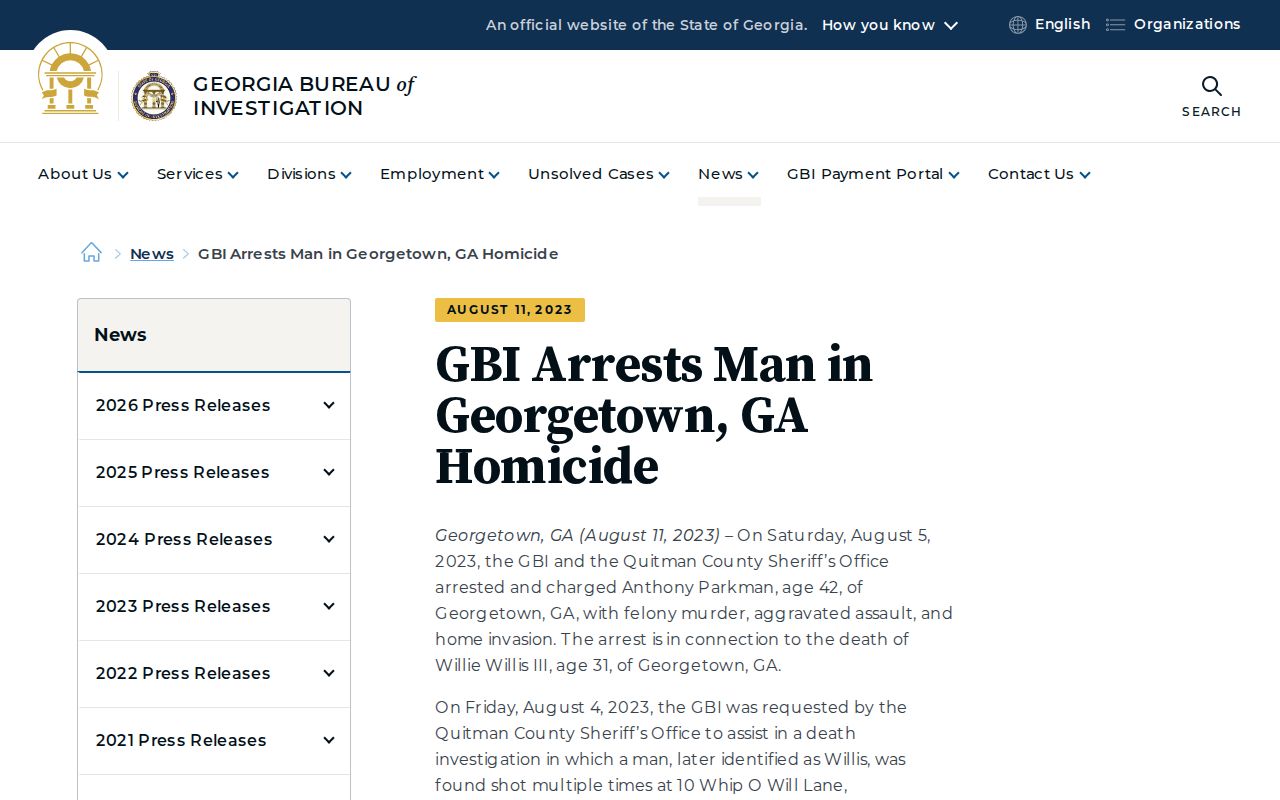
That GBI document is an agency statement. It is not a booking photo or a gallery. It links a Georgetown event to an official account. Current custody and case outcomes still come from the sheriff, the receiving jail, and the court.
Note: Treat WALB and WTVM as discovery channels, not complete lists of Georgetown bookings or court outcomes.
Why Georgetown Bookings Cross County Lines
Here is the wrinkle: custody often crosses county lines. The Unified Government's February 9, 2021 minutes document a Randolph County Jail agreement. The GBI's August 2023 Georgetown homicide release placed the accused at Randolph County Jail. Older regional reporting from 2012 describes Georgetown defendants taken to Miller County Jail instead. None of this fixes a rule. Randolph and Miller are simply the receiving facilities these sources name. Confirm the actual jail with Quitman each time.
Who made the arrest and where the person sits are two different facts. The sheriff may hold the arrest report. The receiving jail keeps the custody entry, release sheet, and booking photo. A name missing from a jail record tells you little on its own. The person could have been released, transferred, or never held there. Trust the facility the sheriff names.
| Question | Record path |
|---|---|
| Who made the arrest? | Quitman County Sheriff's Office, with the arresting agencies named in the case record or official release. |
| Where is the person held? | The current receiving jail, confirmed case by case through the sheriff. |
| Where is the intake photo? | The receiving jail if it created or retains the existing booking image, subject to the request and applicable law. |
| Where is the later state custody record? | The Georgia Department of Corrections offender search, when state custody applies. It is not a county booking roster. |
The Old Jail Is Not Live Custody
Georgetown's Old Jail looks official in a search result. It is not. The building is a historic property, not a working detention site, and the National Register documentation records that it stopped serving as the county jail and was kept up by the Georgetown Garden Club by 1980. The county's 2019 plan gave it probate and deputy-registrar duties. That history explains why a listing labeled "Quitman County Jail" can send a custody searcher down the wrong path entirely.
Custody check. An Old Jail reference never proves someone is held in Georgetown now, so confirm the receiving jail with the Quitman sheriff.
Searches drift across state lines easily. Georgetown County sits in South Carolina. Quitman is a city in Brooks County, and Quitman County in Mississippi is its own place. A "Quitman" address does not tie anyone to a Quitman County, Georgia arrest. Match the agency, the county, and the facility before trusting a name or photo.
Georgetown Busted Mugshots and Court Results
A booking record is early paperwork. The final result lives with the court. To learn how a Georgetown arrest case ended, call the Quitman Superior Court clerk at 229-334-2578, or use the clerk's official information plus the Georgia Courts e-access route. Filings there can show amended charges, a dismissal, a plea, a verdict, or a sentence, and that outcome can differ from the charge logged at booking. Read the court record itself rather than leaning on an arrest report or news story for the full account.
Record distinction. The sheriff record shows how the arrest was documented. The receiving jail answers present or past custody. The court disposition answers how the case ended. Read all three together.
County custody and state custody are separate chapters. A sentence into Georgia Department of Corrections hands the person to a state system, and the GDC Find an Offender search is not a Georgetown roster or a stand-in for the sheriff's booking record. Meanwhile, a booking can vanish from a jail channel while the arrest report and court file live on as separate requests.
The careful path through Georgetown records stays simple. Confirm the arrest with the sheriff. Confirm the receiving jail. Request what each office holds, then check the court disposition. That order keeps current custody, booking history, news, and legal outcome from blurring into one another.
Note: News reports and old archive cards carry early claims, but only the later court record documents the disposition.